Designing for Discovery
A Conversation with Regal Leftwich, Hanbury's New Laboratory Planning Director
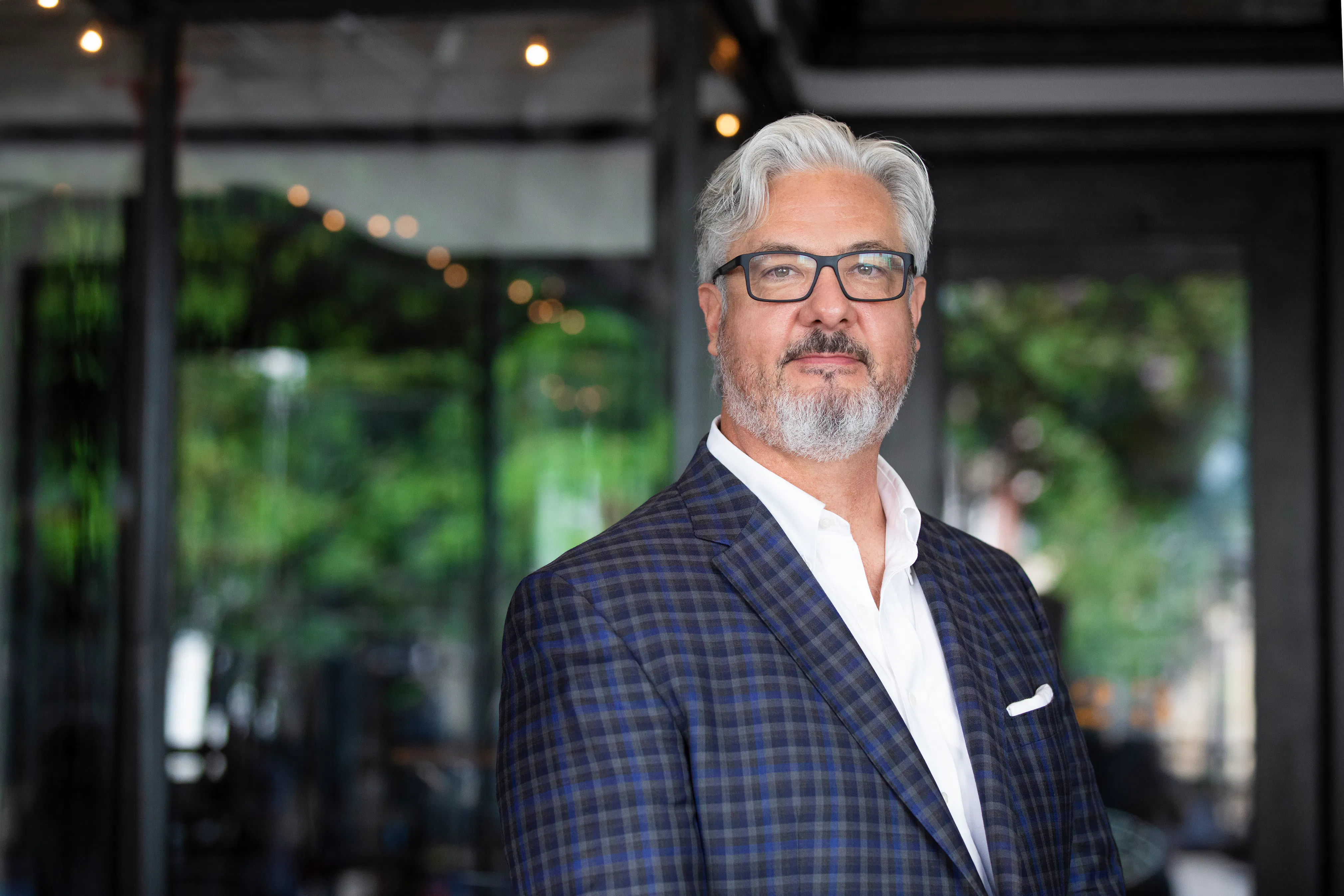
Regal Leftwich, FAIA, recently joined Hanbury as Laboratory Planning Director, bringing an extensive career designing research environments for leading academic, institutional, and corporate clients. We sat down with him to talk about the culture that drew him to Hanbury, how laboratory planning is evolving alongside AI and the rise of interdisciplinary research, and what he's building next.
When Regal first got to know Hanbury, what stood out wasn't a project or a pitch. It was the people.
"What ultimately drew me in was the focus on people," he says. "I got to know the team, saw how they work, and it just felt different. Someone at the firm described Hanbury to me as 'a corporate detox,' and that landed. I saw a values-oriented practice rather than a profit-first or growth-first one."
For a senior leader with his credentials, Regal was elevated to the AIA College of Fellows in 2025, the decision to join a firm like Hanbury says something about where he is in his career. "I've done a lot of what I set out to do," he says. "What I care about now is building a great team. That's where my energy is. I feel like this is a place I could have real impact, build something, and make a home."
"Regal's arrival marks a milestone for Hanbury's Science practice. As a nationally recognized leader in Laboratory Planning, he brings a depth of expertise, vision, and collaboration that will strengthen our ability to deliver innovative, high-performance environments for our clients," says Pat O'Keefe, COO. "His experience across complex corporate and academic research facilities aligns seamlessly with our commitment to design excellence and technical rigor. We are confident that Regal will not only elevate our capabilities but also help expand our impact in the science and technology sectors as we continue to grow. We are thrilled to welcome him to the firm."
Ask Regal to explain laboratory planning to someone outside the profession, and he'll start with the science itself.
"Laboratory planning is about making sure we're building the right space for scientists to have accuracy and repeatability in their experiments," he says. "The building becomes an extension of their science." Labs differ from most other typologies because they carry an unusually dense stack of regulatory and safety requirements, from biological hazards and radiation to electrical loads and moving equipment, and getting those right is the price of admission, not the work itself.
The more interesting part, in his view, is what happens after the technical requirements are met. Scientists, Regal is quick to point out, use both sides of the brain. They're highly analytical and mathematical, but they also have to be creative. Designing for discovery means designing for the unknown.
"Most experts can deliver a functional lab," he says. "What makes a lab sing is how the people in it actually feel. Is there room for a little constructive chaos? Do researchers have the time and space to think about something new? You can't get there unless you understand how they want to work."
That translation work, between how scientists think, how architects design, and how engineers build, is what Regal describes as the real value of a lab planner.
"Nobody grows up saying 'I want to be a lab planner,'" he says. "It's not really taught in universities. Every lab planner I know has their own origin story. They were an engineer, or a scientist, or came at it sideways from architecture. Part of what we do is act as translators between those worlds. That translation layer is where the real value sits."
"Most experts can deliver a functional lab. What makes a lab sing is how the people in it actually feel."
When Regal talks about the future of research environments, two shifts dominate the conversation.
The first is artificial intelligence. As automation enters the lab at scale, and as human and AI interaction becomes part of the daily workflow, the shape of the physical space itself is changing. "We're at a real turning point in how scientists are going to work," he says. "Collaboration patterns will change. Space needs will change. I think we're going to see rapid discoveries, and the spaces we're designing now need to anticipate that shift rather than lock researchers into yesterday's models."
The second is the steady dissolution of disciplinary silos. Biologists used to work with biologists. Chemists with chemists. Physicists with physicists. That model is giving way to hybrid research teams where the biologist sits next to the computational scientist sits next to the engineer, and where the most interesting discoveries come from the collisions between them.
"Those cross-disciplinary interactions produce ideas you literally cannot get in a silo," Regal says. "But you still need to preserve depth within each discipline. So you're designing a kind of matrix, spaces where experts can go deep within their field, and where the connections across fields are constant and easy. Building environments that support both at once is one of the most interesting design problems in the field right now."
Getting those environments right, he says, starts with understanding that every client is different. "Every institution has its own research culture. You really have to understand what's working and what isn't before you start designing. Sometimes clients say, 'Our lab is fine, just replicate it.' And then you walk in and there are no windows, and it's miserable, but they're doing great work anyway. The question I want to ask is: how do we make a space that's actually full of inspiration and wonder?"
Regal is clear about what he wants to build at Hanbury, and the vision is unmistakably about people.
"The question I keep coming back to is: how do you create the kind of place where the best people in the industry want to come and work? That's my vision. Hanbury already has a strong culture. My job is to build a science practice on top of that foundation that attracts top talent, delivers excellent work, and stays in front of where research is going. If we do that, everything else follows."
That vision lands squarely with how Hanbury's leadership thinks about growth.
"Our growth over the past decade has been largely around attracting and growing our talent, creating an environment where they can thrive, and collaborating to do work that makes a difference," says David Keith, CEO. "Regal understands that the strongest science practices are built around the strongest teams. His instinct to lead with people reflects how we think about building a practice."
For Regal, the through-line connecting all of it, the firm, the discipline, the future of the lab itself, is a simple question about why scientists become scientists in the first place.
"Most of them have a story about being fascinated by how the universe works and wanting to learn more," he says. "The spaces they work in should reflect some of that childhood aspiration. That's what gets me out of bed in the morning. The idea that we're improving humanity by improving the places where science happens. I want to be part of that."