Asking Better Design Questions
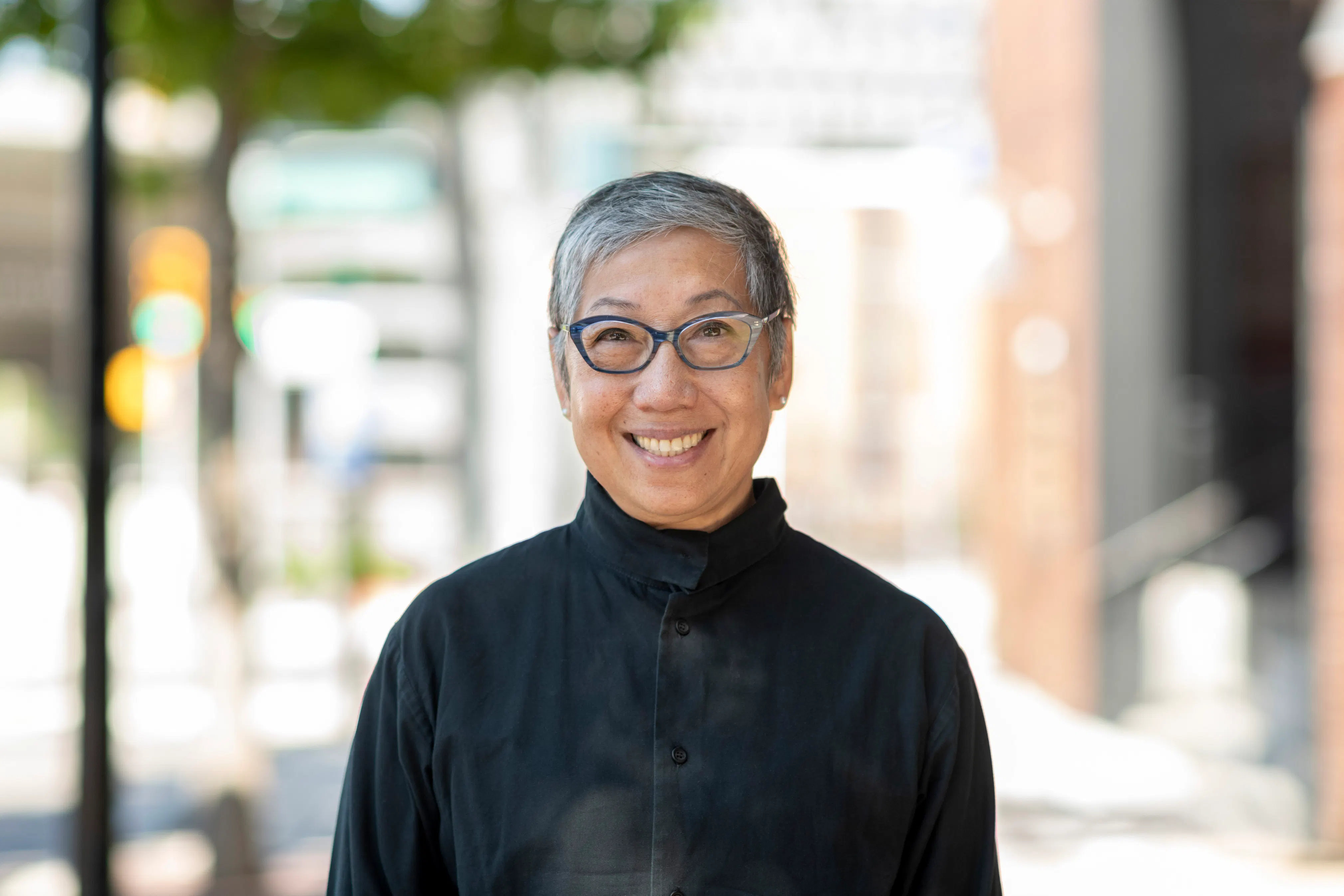
A Conversation with Principal and Laboratory Planner Mitsy Canto-Jacobs
When Mitsy Canto-Jacobs sits down with a scientist to plan a laboratory, one of the first things she wants to know is what could go wrong.
“What do you think a designer could get wrong that we cannot get wrong here?”
The question is deliberately direct. Scientists know their work, their equipment, and the frustrations of spaces that have failed them before. Asking what cannot be missed gets past assumptions and begins to reveal what the laboratory actually needs to do. It also says a lot about Mitsy.
Across more than two decades of planning research environments, including high-containment and infectious disease laboratories, she has helped clients create spaces for everything from viral vector research and hydrogen fuel cell development to material science and behavioral studies. Her approach has always centered on understanding the science by asking questions, challenging assumptions, and following the evidence.
Since joining Hanbury, she has turned that same curiosity toward the firm itself, digging into past projects and uncovering technical experience that creates new possibilities for the Science practice.
We sat down with Mitsy to talk about what she’s discovering at Hanbury, her approach to working with scientists, and why she rarely takes the first answer at face value.
You’ve spent a lot of time digging into Hanbury’s existing Science work since joining the firm. What have you found?
There’s a lot here. That has probably been one of the most refreshing things about joining Hanbury.
I’ll look at a project and start asking what was actually involved. What was the program? Was there a specialized space? What technical challenges did the team solve? Then I talk to the people who worked on it, and I keep finding deeper experience than you might see at first glance.
Sometimes the people who did the work don’t think of it as particularly remarkable because they were simply solving the problem in front of them. I look at it from the outside and think, “Do you realize what you did?”
Part of what interests me is helping connect those experiences and think more expansively about where they can take us as the firm expands into other types of labs.
How does that mindset translate to your work with scientists?
Scientists usually know what they want, but they may not know what else is possible. My job is to understand their science well enough to show them possibilities.
When I start a lab planning conversation, I need to know what science they do and what equipment they use. But some of my favorite questions are, “What do you think a designer could get wrong that we cannot get wrong here?” and “What is the workflow in the lab?”
Scientists have often worked in laboratories where something didn’t function the way they needed it to. Asking directly about that experience gets us past assumptions. Then we can determine what is truly specialized, what is relatively standard, and where design can make a meaningful difference.
I don’t want to walk in with a predetermined module and tell everyone this is how their lab has to work. You might save something initially, but if the space doesn’t support the science, you’re going to pay for it later.
Curiosity seems to play a large role in how you work.
I think you ask questions because you wonder why something can’t be better.
But curiosity doesn’t mean accepting every new idea. I’m curious, but I’m also skeptical. When everyone is rushing toward something because it is supposed to be the next great thing, I tend to want to understand its limitations first.
I’ve always been comfortable saying, “I don’t know this yet, so how do I figure it out?” You research it. You ask somebody. You compare what you find. If a tool doesn’t work, you figure out why it doesn’t work and whether another one does. That also means being willing to explore an unfamiliar project type instead of immediately deciding, “We don’t do that.”
There is obviously a line between exploration and taking inappropriate risk, and experience helps you understand where that line is. But I’ve found that people are often capable of much more than they initially think if they’re given room to investigate the problem.
Science has changed enormously over the course of your career. Has laboratory planning changed with it?
The science absolutely changes. When I started my career, some of the things that are commonplace in laboratories now were emerging fields. Safety expectations have evolved significantly as well. But scientists haven't changed nearly as much.
They understand the techniques they use. They understand what they need to do their work safely. And when they can explain what they do and what concerns them, they make our work much easier.
Scientists don’t change. The science they do changes. Ultimately, laboratory planning still starts with people.
Where does your instinct to keep questioning things come from?
My parents were doctors, so my entire childhood was built around one idea: get a second opinion.
Someone would tell me something and the response at home was always, “Did you check? Who did you ask? You didn’t only ask one person, did you?” Apparently that stuck.
It’s how I think about technology now, too. I don’t want one platform giving me an answer and then assume it must be right. Compare it. Check another source. Understand why the answers are different.
It is really about staying curious enough to question the first answer. Maybe that’s what I’ve been doing all along, getting a second opinion.
Mitsy Canto-Jacobs, AIA, is a Principal Laboratory Planner at Hanbury with more than two decades of experience planning R&D, clinical laboratory, and animal research facilities across the United States, Asia, and Africa. Her expertise includes high-containment environments and resilient research facilities, with extensive experience supporting the National Institutes of Health and other government and commercial clients. She holds dual master’s degrees in Architecture Studies and City Planning from the Massachusetts Institute of Technology.